Wednesday, January 23, 2013

Bahrain's Latest Call to Dialogue: Détente or Diversion?

"Ok, guys, we've got two hours to agree on everything."

Yesterday's news that Justice Minister Khalid bin 'Ali has been tasked by King Hamad to restart political "discussions" has been greeted with some cautious optimism. This latest step toward renewed talks comes some six weeks after Crown Prince's surprise call for such an initiative at the Manama Dialogue, a proposal that seemed encouraging on several levels.  Naturally, the (foreign) media have connected yesterday's announcement with Sh. Salman's earlier call, in which case one is perhaps justified in remaining optimistic.  Yet looking at the design and official description of these new "discussions," it is not at all clear that they are one and the same with the Crown Prince's plan.  In which case there is must less reason for hope, and Khalil al-Marzuq's stated worry that the latest announcement may be no more than a "seasonal call for dialogue" is likely right on target.

Looking at the official BNA press release, there are several worrying elements.  It reads:
Based on the royal guidance of His Majesty the King, the Minister of Justice will invite representatives from the political societies and independent members of the political community in Bahrain to resume discussions of the political dimension which was initiated during the National Dialogue. The topics on the dialogue agenda will be those pending issues which have consensus to be listed. This process is aimed to develop further consensus around the political agenda.

This is comes in conformity with His Majesty’s speeches emphasizing on his continued support for a purposeful and serious dialogue as long as it serves the Kingdom and its people.
The first notable fact is the conspicuous omission of any reference to the crown prince's statement at the Manama Dialogue.  In fact, the announcement appears to go out of its way to disassociate itself with the latter, stating explicitly that the initiative is "[b]ased on the royal guidance" of King Hamad and "comes in conformity with His Majesty's speeches."  So, again, nothing about Sh. Salman, an omission that suggests perhaps that his more moderate faction is not the force behind the initiative.

The second worrying element is the mere mention of the National Dialogue of summer 2011, which represents without question the single most farcical and disingenuous initiative of all the farcical and disingenuous initiatives witnessed since February 2011.  Couple this with a statement of support for the new "discussions" by Khalifa al-Dhaharani, the distinguished troupe leader of the National Dialogue (who just happened to have a meeting with the king yesterday), as well as the reference to "independent members of the political community," and one's imagination runs wild.

Moreover, the statement seems to skirt around the question of who precisely was "invited" to the "discussions."  Al-Wifaq we know is included, but has the offer been extended only to the opposition?--or only to the formal opposition (i.e., not to the Feb. 14 coalition)?  The open reference to "political societies" and "independent members of the political community" would seem to suggest that the discussions would not be limited to the opposition.  Yet some reports, including one by the usually-reliable Habib Toumi at Gulf News, are running with the headline, "Bahrain king extends talks invite to opposition."  Whatever the case, the vague language stands in stark contrast to that of Crown Prince Salman, who made explicit mention of the inclusion of Sunni and Shi'i groups, a condition that will surely make or break the entire enterprise.

Finally, apart from the actual text of the initiative, one can note two additional observations. The first is the patron of this new initiative, Sh. Khalid bin 'Ali, who over the previous two years has overseen the dissolution of two opposition societies--Wa'ad (temporarily), and 'Amal--and, on repeated occasions, the attempted dissolution of al-Wifaq itself.  The most recent of these efforts/threats to ban al-Wifaq took place only in September, when the group and Sh. 'Isa Qasim came under pressure by the Justice and Islamic Affairs Ministry, which Sh. Khalid heads and which has legal jurisdiction over Bahrain's political societies.  More generally, Sh. Khalid bin 'Ali bin 'Abdallah bin Khalid is a distinguished member of the Khawalid (a subject that has been occupying much of my time lately), which is to say a member of the ruling family not predisposed to offering substantive political concessions.

Last is the larger regional and perhaps international political context of the announcement.  On the one hand, with the anniversary of the uprising is less than a month away, it is perhaps expected that the state would revert to its old trick of what al-Marzuq calls "seasonal call[s] for dialogue" aimed at diffusing pressure at opportune times.  In line with this interpretation, one Bahraini contact estimates that the effort "seems to be part of a broader plan by the authorities ahead of the crucial second anniversary of 14 Feb." 

On the other hand, one can also identify several external factors that could be conspiring to give King Hamad a kick in the pants on the issue of dialogue.  Second-term "I do what I want!" President Obama has nominated as secretaries of state and defense two individuals who likely represent a different take on the United States' proper role in the Middle East, its stance on Iran, and indeed its strategic goals throughout the rest of the world.  At the same time, Bahrain's oldest great-power patron Britain is in the middle of its own formal parliamentary review of relations with Bahrain and Saudi Arabia. See, for example, Jane Kinninmont's testimony to the committee yesterday:


These hints at changes in philosophy may not translate into substantive changes in the U.S. or British relationship with Bahrain or Saudi Arabia, but the mere suggestion may be enough to prompt Gulf leaders to take more deliberate steps to ensure their own long-term security and stability, including by making headway on addressing longstanding political grievances.  (Say, in Saudi Arabia's case, by appointing women to the Shura Council.) That Bahrain's announcement came just a day after the end of the GCC summit in Riyadh, where the focus reportedly was on the Arab Spring and meeting "people's aspirations," is interesting in this regard.  As always, however, only time will tell.

Update: Well, it seems that Sunni groups certainly are under the impression that they've been invited. (Although this impression has proved erroneous in the past.) The National Unity Gathering has welcomed the dialogue and in fact held public meetings with constituents last night.
Update 2: Not everyone is such a fan, however. The Bahrain Mirror reports that official army spokesman and Internet funnyman Khalid Al Bu'Ainain referred to the dialogue ("al-hiwar") yesterday as "al-himar"--that is, "the jack-asses"--in a Tweet. Hilarious.

Update 3: Blast, another setback!  Al-Wifaq, perhaps in an attempt to demonstrate its control of the Shi'a street and/or ability to mobilize popular support for the dialogue, calls for a rally in Manama.  The Interior Ministry denies permission for the rally.  Members of the youth movement instead take to the streets to denounce the talks, shouting "no dialogue with killers."  Interior Ministry responds with tear gas and stun grenades.  Al-Wifaq looks out of touch and lacking in influence where it matters.  Government likely wonders what good will be a dialogue (and the possibility of a political deal) if the opposition cannot put an end to protest activities even if it wanted.

Coming soon: dialogue falls apart.

Update 4: Here we go.  'Ali Salman tells the BBC that al-Wifaq wants "someone who can speak for the ruling family" at the proposed talks, namely Crown Prince Salman.

Update 5: For those in Washington on Feb. 13, Carnegie is hosting an event titled "The Precarious Ally: Bahrain’s Impasse and U.S. Policy in the Gulf" featuring, inter alia, Toby Jones, Frederic Wehrey, and Matar Matar.  

Wednesday, January 9, 2013

Social Network Analysis of Bahrain

I retreat here from the typical manner of this blog to offer a bit of Wednesday linkage. Hopefully I'll have more time for original content (though Toby Jones' analysis more than suffices in this case) once I finish with some writing commitments. Among these is an interview on the subject of sectarianism that should appear soon in Jadaliyya.

  • First, as already mentioned, Toby Jones tries to win hearts and minds in Washington with a perfectly-argued op-ed: "Obama Should Reconsider US Approach to Bahrain."

  • Next, in an attempt to fill the obvious void of political factions in Bahrain, a new group calling itself "Bahrain Liberals" has emerged with a flashy website/blog and concerted PR campaign. (I received an unsolicited e-mail announcing the group's "vision" last night.) The writings are actually quite coherent (not to say persuasive), but so far the content seems to focus a lot on how bad al-Wifaq and 'Isa Qasim are and not so much on liberalism.

  • Last but not least, a few months back I received an e-mail from a student asking if he could use my sectarian map of Bahrain to map the country's local news media outlets (i.e., village forums). The project sounded quite promising, and now we have a taste of the result:


  • A full explanation of the technique is posted on his site, but in short he applies network analysis--now all the rage in political science as elsewhere--to help understand the case of post-uprising Bahrain. Apart from the map of local media outlets, this effort also includes maps of Bahrain's various social/political networks, including the country's Twitter community/ies as well as the Bahrain Center for Human Rights. Interesting stuff worth checking out.
Update: A BCHR press release has announced that Maryam al-Khawajah will arrive in Bahrain later today in what appears to be a fait accompli. How the state reacts to her visit, which is the first since the uprising and will ostensibly involve visiting her father and others in prison, will be a good indicator of where the balance of power rests today in the country. The last high-profile activist to have escaped being forcibly silenced, conservatives in the ruling family and in society will be chomping at the bit to finish what they've started. It is shaping up to be an interesting two weeks.

Update 2: The Bahrain Mirror is running a lengthy and interesting interview (in Arabic) with Emile Nakhleh complete with contemplative photograph. I am told that an English version will soon follow.

Sunday, January 6, 2013

The View on Bahrain from Britain

A friend passed along a link to this interesting document containing the written submissions pertaining to the ongoing and, in Riyadh especially, somewhat controversial parliamentary inquiry into "The UK's relations with Saudi Arabia and Bahrain." (One hopes the investigation is handled with more care than suggested by the report's copy-editing.) Of course, since Britain has, according to Crown Prince Salman's glowing review at the Manama Dialogue, "stood head and shoulders above others" in supporting the country, I'm sure Bahrain has nothing to worry about.

The 200-page report includes many familiar faces both from Britain and abroad, representing British academics and officials, Bahraini officials, Bahraini and international human rights organizations, and even LuaLuaTV. Accordingly, not all are equally useful or interesting, but many are. I especially enjoyed reading the matter-of-fact testimony of former British Ambassador to Bahrain (1981-1984) Sir Roger Tomkys (pp. 6ff.). After reviewing the history of British-Gulf and British-Bahraini relations, he arrives finally at what he terms "The Systemic Problem":
Nevertheless, there is a long term systemic problem which is simply that the Royal Family, with their close adherents took over Bahrain in the eighteenth century as incomers from the tribal, nomadic society of Arabia, and have ever since ruled over the indigenous, sedentary Baharna majority. That the Al Khalifa are Sunni and their subjects Shia makes matters worse but is not the prime cause of friction, which is the natural dissatisfaction of a majority permanently excluded from supreme power, together with resentment at the privilege of the ruling class. Over time the level of discontent has fluctuated and for long periods the Al Khalifa have coopted the support of the majority. But it was natural that events in Tunisia and Egypt should trigger (not cause) a crisis in 2001.

This systemic problem is made worse by historic Iranian claims to sovereignty over Bahrain. This claim, withdrawn by the Shah in 1971, was reactivated by the Islamic Revolution in 1979, with the added factor of Iranian aspirations to defend Shi‘a communities throughout the region. The Gulf Arab response was to establish the Gulf Cooperation Council (GCC) as a common shield against Iranian (and in another context, possible Iraqi) encroachment. Even so, there was a failed assassination/coup attempt in December 1981, shortly after my arrival; the background was never clear but the Government blamed Iranian subversion.

By no means all Baharna are opposed to Al Khalifa rule and not all opposition activists are Shia. In an older generation young men from all backgrounds might be Nasserite or Baathist firebrands and later became pillars of the establishment. Now their successors are Salafist Sunni, whose wish to end Bahrain’s liberal ways threatens the economy but this is a wider issue for the Islamic world, not endemic to Bahrain. Meanwhile, a substantial educated middle class are keen to see better, more accountable Government, but are fearful of Islamic enthusiasm and its implications. ...

To put in perspective the prevailing image of Bahrain as a society divided on antagonistic religious lines, where Sunni rulers and oppressed Shia never meet, let me record my own experience in the 1980’s. It was my practice as Ambassador to attend the family mourning assemblies whenever any prominent figure died. On several occasions at mourning for a member of the Shia community, I found the then Ruler or his brother the Prime Minister, present on the same errand to pay his condolences; there was no pomp, circumstance or security. In some respects it was still like a small village community, with much of the mutual respect that implies.
 And, finally, the crux of the problem, stated once again in a refreshingly direct manner:
Solidarity within the GCC and support from Saudi Arabia are not cost free. With close family and social links, Bahrain is economically dependent on its major neighbour but they are very different societies. While liberal, inclusive, religiously tolerant Bahrain has turned these differences to its economic advantage, Saudi financial support and access to Saudi oil at a preferential rate remain essential. This comes at a price.

Saudi Arabia has its own problem with a significant Shia minority in the Eastern Province. This minority and the Baharna are historically close. Their situation is exacerbated because for the religiously hard line Wahhabi Saudis, Shiism is anathema; and because the despised Shia live and work in the oil producing region. There is no way the Saudi Government would allow the Al Khalifa, even if they so wished, to introduce full Western style democracy power in Bahrain; the risk of knock–on to the Eastern Province would be judged unacceptable and some form of Saudi takeover of Bahrain would almost certainly follow. ...

There is no realistic alternative to Al Khalifa rule that would improve the lot of the Baharna, so long as the House of Saud rule in Arabia. Radical democratic reform in Bahrain would not be tolerated by Riyadh. If direct Saudi control were asserted there would be little economic role for Bahrain without its liberal “unique selling point” and all Bahrainis would suffer. The best outcome from the recent crisis would, of course, include real reform measures to improve government accountability and to prevent abuse of police powers.

It is vital that there should be credible interlocutors on the side of the opposition if reform is to succeed. Not all the opposition is Shia and not all the Shia want the fall of the Al Khalifa. Past unrest has been Nasserist; more recently Sunni political Islamists have tried to hijack the infant democratic institutions and to end Bahrain’s liberal customs. Moderate voices need to be heard.
I highly recommend at least browsing the other testimonies, including that of Kristian Ulrichsen, in the report.  Many offer the insights of a different group and indeed different generation of individuals than those we are accustomed to hearing.

Finally, a bit of news news.  No, that's not a typo: several recent items out of Bahrain involve news, or more accurately the lack thereof.

The first is an alarming trend toward the silencing of Bahrain's professional photographers and cameramen, the seeming final step in the government's goal of achieving a total non-state journalism blackout. 

Second, and related, is an odd item passed along by another friend involving Al-Ayam. The paper ran the following story about an altercation at the Foreign Ministry involving one Sh. Muhammad bin Salman bin Saqr Al Khalifa and an employee, Nayf 'Abd al-Hameed Al-Kuwaiti, in which the former supposedly attacked the latter and threatened to shoot him over a dispute initiated on Twitter. Apparently, the royal was not an employee of the Foreign Ministry but forcibly stormed the building in search of Al-Kuwaiti, whom he obviously found.  In response, and as reported in the screenshot below, the Foreign Ministry "strongly deplore[d] the assault by Sh. Muhammad bin Salman bin Saqr Al Khalifa on one of the ministry's employees." 


But, silly Al-Ayam, thinking it could question the actions of a member of the ruling family, was soon forced to remove the story.  According to opposition news network LuaLuaTV, the order came from "the royal court" and involved "the intervention of the field marshal [Sh. Khalifa bin Ahmad]." (Marc Owen Jones has some additional details, as well as a more thorough translation of the Al-Ayam story, here.)

Finally, although this is now two weeks old, it is worth mentioning the LACK of any real news or usual grandiose posturing out of the recent (Dec. 24-25) GCC summit in Manama.  Already in early December the Gulf News reported that the "summit will not announce Gulf union"--shocker there--but, even apart from this, the meeting did not seem to garner any press coverage at all.  I for one demand more denouncements of Iranian interference and unrealistic plans for political, economic, and manned space program integration!

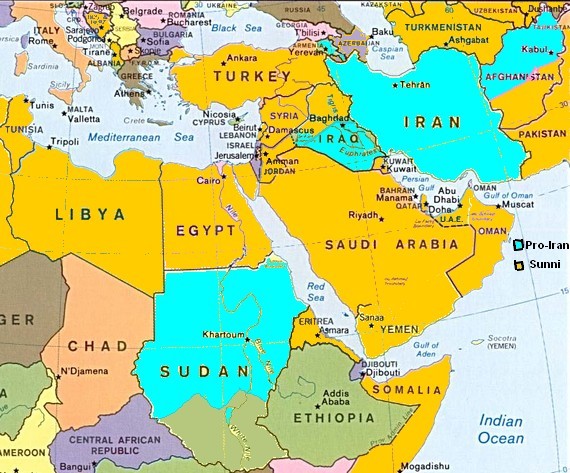
Thursday, January 3, 2013

Cole on "Rise of the Sunnis" in 2013

The crumbling Iran/Shi'a crescent (in blue) if Damascus falls (Source: Cole)

Some interesting new year's prognostication from Juan Cole, who sees for the Middle East in 2013 "the Rise of the Sunnis and the Decline of Iran, Iraq and Hizbullah."

Bahrain, on the other hand, is "proceeding confidently on the road to the brightest future in 2013," according to this collaborative article between the Bahrain News Agency and The Onion:
Despite shortage of fiscal resources and unfavorable repercussions of unrest sown by a handful of bust outlaws, the Kingdom of Bahrain has been ranked amongst advanced nations of the world. The wheel of productivity goes on unfettered, as Bahraini citizens and expatriate residents carry on business as usual.

The Kingdom's impeccable human rights record and bright image remain intact and undistorted by any futile false allegations propagated by hostile megaphones at international functions. The rate of economic growth reached 3.1% in the third quarter of last year (2012) and is likely to reach 4% this year with an increase of 0.7% thanks to non-oil-related economic activities of added value which recorded a realistic growth rate of 5.9%.
Indeed, Bahrain's economic growth forecast was likely boosted 0.7% on New Year's eve alone, as the Saudi newspaper Al-Youm reports that more than 80,000 vehicles--or nearly 250,000 people at 3 individuals per vehicle--piled onto the causeway into Bahrain for some decidedly "non-oil-related economic activities."

Monday, December 31, 2012

When What Happens in the Villages Doesn't Stay in the Villages


While conducting my survey of Bahraini citizens in 2009 I spent a good amount of time in the island's (mainly Shi'a) villages, attempting to convince potential respondents that my field interviewers and I were not government spies and so on. As a consequence, I was afforded an interesting opportunity to witness first-hand village life, and the everyday difficulties that this geographical, socioeconomic, and in many ways political isolation entails.

One elderly villager in the seaside Shi'a enclave of al-Malikiyya told how he was banned from fishing in the bountiful waters adjacent to the village when large palace compounds were erected all along the Western coast. When asked about a dilapidated fence blocking what looked to be a beach in Sitra, villagers recounted how a young boy had drowned when sand was illegally dredged from the shore, creating a steep drop-off. The fence, they said, was the municipality's solution. And, in the northern village of Karranah, a resident complained bitterly that the police themselves refuse to enter unless to make an arrest or to chase away teenagers burning tires. Even in the event of a simple car accident, he explained, exasperated, the police demand that villagers themselves drag the damaged vehicles to the main (al-Budaiyi') road for examination, so that any facts of the incident gained by observing the wreckage or through interviewing witnesses are necessarily lost.

As a result, many of the Shi‘a villages, though the capital and most ministry headquarters be but five miles away, have learned to operate to a startling degree independently of the state, referring disputes to local notables, aiding poorer residents through the local village charity, and undertaking infrastructure repairs and construction. They also, as one might expect, have come to have little trust in the state's various agents, in particular the police--and this well before their brutal role in suppressing the February 14 uprising. Several questions in my 2009 survey asked respondents to indicate their level of trust in several government institutions, among them the police. Predictably, Shi'a respondents expressed little confidence in the latter, with only 7% indicating "a lot of trust" in the police and only 25% even a "moderate" level of trust. Instead, nearly half of all Shi'a respondents said they had "no trust at all." And this, again, was nearly two years before February 2011.

In stark contrast, very few Sunnis--a combined 15%--expressed anything less than "moderate" trust in the police. Indeed, the police earned more trust among Sunnis than any other institution inquired about in the survey save for the prime ministership. (The others were the parliament, political societies, and the courts.) This too is perhaps unsurprising, given the survey's other finding that 13% of all Sunni households had at least one member (husband or wife) employed in the police or armed forces.

Of course, it may also have something to do with the fact that, with the exception of Ebrahim Sharif, Mohammed Al Bu Flasa, and a handful of others, Sunni citizens are not regularly and needlessly harassed, insulted, and/or assaulted by police. Even apart from the disproportionate involvement of Shi'a in protest and opposition activities, the extreme isolation of many/most Shi'a communities would seem to embolden police, encouraged by presumed anonymity and impunity to adopt the slogan of another sin city: "What happens in the Shi'a villages stays in the Shi'a villages."

Except, that is, when someone records it on a cell phone camera and posts it to YouTube. In that case, you get the following, which France24 has dubbed "the police slap heard all over Bahrain." The setup according to the cameraman:
That day, Haider was on his way to visit his aunt, who lives very close by, which is why he didn’t have his papers on him.

The neighbourhood where his aunt lives was full of policemen, because Bahrain was preparing to host the Gulf Cooperation Council summit [on December 24 and 25] and the government feared that protests might take place.

What you don’t see in the video is that a policeman first stopped Haider’s car and asked him to step out of the car. Haider agrees, but refuses to leave his child alone in the car. The tension is palpable, which is why the eyewitness decided to film the scene from his window [the video begins before the father enters the frame, as if the cameraman was indeed waiting for something to happen].
And the video:


The Interior Ministry has since been reported to have detained the offending officer, presumably to reprimand him for drawing negative attention to the country's now-reformed police force (not to be confused with reprimanding him for slapping the villager). Conveniently for Bahrain, this also coincides with another legal case against "rogue" policemen.  Yesterday two officers were given seven years in prison each for the beating to death of Kareem Fakhrawi, who in April 2011 dared to complain to police about the demolishing of his house by... the police. For those keeping track, the seven-year sentence is only three times shorter than the 25-year sentences handed to several of the opposition leaders last June by closed military tribunal, and about infinity times shorter (infinity divided by 7) than the life sentences given to 'Abd al-Wahhab Hussain, Hasan al-Mushaimi', Muhammad al-Miqdad, 'Abd al-Jalil al-Singace, and four other main opposition figures.

So it's been a great week for evidence of police reform in Bahrain.

Sunday, December 16, 2012

National Day in Bahrain: Yet Another Thing People Can't Agree Upon

Although Bahrain formally gained independence from Britain on August 15, 1971, it marks its National Day--technically, "National Day and Day of Coronation"--on December 16, the day on which Sh. 'Isa officially assumed the throne. In protest of this seeming desire to elevate the monarchy above independence, members of the opposition (and probably others) routinely mark a shadow "National Day" on August 15 and deride that celebrated in December.

Thus has some poetic Bahraini photoshopper hit upon the following pun addressed to King Hamad: "The people wish you the best seat [jaloos] on the occasion of Coronation Day ['eid al-jaloos]."


And, on the other side, a National Day paean to King Hamad's sons Nasr and Khalid, who express their patriotism the old fashion way: by jumping out of an army helicopter:

Tuesday, December 11, 2012

With New Plans for Dialogue, February 14 Uprising May Come Full Circle

How fitting it would be if Bahrain's uprising were finally resolved in the same manner in which it originally was not resolved--with a political deal brokered by the crown prince--an appropriately absurd result to highlight even more starkly how far the turmoil, bloodshed, and political posturing of the previous two years accomplished *literally* nothing.

The most decisive moment of the uprising was of course the two days March 12 and March 13, in which time Sh. Salman failed to coax opposition leaders to the bargaining table despite offering a generous seven-course menu of thorny political issues that he, and by implication King Hamad, was ostensibly prepared to discuss.  Al-Wifaq demanded the government first agree to an elected constitutional assembly empowered to revise the 2002 charter, and got nothing.  The ill-fated Coalition for a Republic demanded--well--a republic, and got thrown in jail.  And, finally, senior Al Khalifa conservatives demanded that the king's son (as my friend Jeremy Cochrane's dad used to say) stop horse-assin' around, and got in touch with their friends from Saudi Arabia to help put an end to all that crazy dialogue talk.  

Now, nearly two years later, history may be on the brink of (hopefully not) repeating itself, with Crown Prince Salman issuing a surprise call for renewed political talks at last week's appropriately-named Manama Dialogue conference.  While some criticized the event both for its percieved legitimation of the government's position as well as for the seeming lack of attention on Bahrain at a forum on regional security (I will acknowledge that I underestimated its usefulness and, later, the seriousness of Sh. Salman's announcement), it seems--and I've heard from some who would know--that Bahrain was indeed on the agenda.


Sh. Salman's Speech

Of course, the sudden transmutation of the crown prince into a relevant political figure in Bahrain does not guarantee that this latest attempt at dialogue will fair any better than the last.  There are, however, some reasons to be encouraged.  In semi-particular order:

1.  A senior and (more or less) neutral royal is finally taking the lead.

Following Sh. Salman's very public March 2011 failure, the government set out to ensure that it would not be embarrassed again.  To this end, its choices of sponsor for subsequent dialogues--or what it called dialogues--were either powerless to broker any actual agreement (Khalifa Al Dhaharani, during the National Dialogue); or so uncompromising that it could be sure not to lose face (Sh. Khalid bin Ahmad, earlier this spring).  The problem with Al Dhaharani, and with the entire National Dialogue, should be clear enough.  The main problem with Sh. Khalid was that he was hopelessly partisan: not only does he despise the opposition (and Shi'a generally), but he is an active supporter of one segment of the Sunni counter-opposition.  This leads directly to encouraging sign number two.

2. Bahrain's Sunnis will not be excluded.

The most recent attempt to restart dialogue sponsored by Sh. Khalid ultimately was scuttled because it was stuck in the old paradigm of backdoor talks between the government and opposition.  Entirely excluded from the negotiating table, that is, were representatives from Sunni society, and this despite Sunnis' decisive role in checking the momentum of the uprising in February and March 2011.  Upset that the state would seek to negotiate without their input, the National Unity Gathering and Sahwat al-Fatih both rallied against the still-theoretical dialogue, and it was never to be heard from again.

By contrast, the crown prince's new initiative will reportedly take the form of "a conference on human rights that would bring together Shia and Sunni parties and pave the way for a political dialogue." 'Ali Salman also is said (in the same Financial Times article) to have agreed to three-way talks.  Certainly, many Sunnis will continue to oppose on principle any government talks with the opposition.  They will (and, as will be discussed shortly, already are) decrying the weakness and stupidity of a government that negotiates with "terrorists."  Yet, as demonstrated already in the case of Sh. Khalid's failed initiative this spring, a sizable proportion of Bahraini Sunnis will welcome the opportunity to articulate their own political grievances and vision, something they have not often had the occasion or liberty to do.

3. The United States is not involved.

Somehow, the crown prince was able to achieve a two-for-one coup at the Manama Dialogue.  If his plan to resume talks remains the top headline, not far behind is his alleged "diplomatic flap" and "public slap against Washington" (per the Associated Press).  As described by Simon Henderson,
U.S. diplomats at the conference ... were surprised when [the crown prince -- ]previously seen as the royal family's leading reformer -- failed to mention the United States by name when listing allies that have provided critical support during the disturbances. He also spoke of countries that "selectively" criticize Bahrain's leadership, without citing specific examples.
Aww SCHNAP! Not citing examples? I bet he didn't show his work either.

Henderson continues,
Meanwhile, Deputy Secretary of State William Burns, who led the U.S. delegation, emphasized "the urgent challenges of Iran's reckless behavior." On reform, he stated, "There is no one-size-fits-all approach to such transitions or reform processes; much will depend on local circumstances and the quality of local leadership." However, he also noted that "Long-term stability, and enduring security, depend on the full participation of all citizens in political and economic life; the belief of all citizens that their peacefully expressed views are heard and respected; [and] the conviction of all citizens that they share a stake in their country's future." In the email text of the speech distributed by the State Department, the three mentions of the word "all" were each in bold type.
Ya, that's right, you heard him: bold!

Like others, Henderson concludes that "[t]he exchange suggests that the gap in perceptions between Washington and Manama is as wide as ever"; and that, "[g]oing forward, two dangers threaten U.S.-Bahraini relations. The first is that Iran will attempt to further weaken the relationship; the second is that Washington has made seemingly little effort to repair it."

All together, now: GOOD!  If there is one sure-fire way to derail any attempt at political compromise in Bahrain, it is by involving--or even hinting at the involvement of--the United States.  Do we somehow need to be reminded of the "Ayatollah Obama" columns in Al-Watan?  And of the National Unity Gathering rally against the quadrilateral terrorist axis of Iran, al-Wifaq, Hizballah, and the United States?  And of the defense minister's explicit claim of a U.S.-Iranian conspiracy behind the uprising?

In fact, I would hazard that this public "affront" is a bit of well-calculated political theater aimed at (1) ensuring Bahrainis that the U.S. is not involved in the crown prince's initiative; and (2) distancing him from the U.S. altogether--indeed, maybe even earning him a few points with (the mainly Sunni) critics of American "interference" in Bahrain.  It is certainly a more clever crown prince comeback plan than sending him home from Washington with a few spare helicopter parts and humvees.  And since the State Department has already tried that twice, and failed twice, perhaps a change of strategy is even to be expected here.

4. The formal opposition is on board but remains defiant.

Here we have another delicate balance that must be achieved if dialogue is to succeed or even proceed: the formal opposition (i.e., al-Wifaq) must remain defiant enough to be seen as representative of and, from the state's perspective, in relative control of the protest movement, while at the same time not so provocative as to aid in the (inevitable) mobilization of security-minded citizens and royals against the intitiative.  'Ali Salman's fiery but still moderate speech last Friday--in which he lectured and corrected those chanting the familiar "down with the regime" slogan--is seen to indicate that al-Wifaq has now grasped the importance of this dialectic.

As you see from the following video excerpt (others are on al-Wifaq's website here), his voice says pissed off and maybe a bit crazy, but his words say coherent and reasonable.  That's what al-Wifaq needs to aim for, as eventually they will (if talks are successful) be asked to convince their own constituents to accept the deal they have bargained. (You can follow the opposition forum debate over his speech here.)


It looks like al-Wifaq and the rest of the formal opposition will keep the pressure coming, with another (now-illegal) rally planned for Friday titled "The People's Demand is Democracy":


5. Hardliners are flipping out. 

Finally, perhaps the most encouraging sign that Sh. Salman's new dialogue initiative may actually come to something is that security-minded citizens and Al Khalifa conservatives are already desperately rushing to the offensive. Indeed, Al-Watan's editorial page today is going an impressive 4-for-4 on anti-crown prince dialogue stories, including one by anti-American specialist-turned-editor-in-chief (and personal spiritual and menu adviser of this blog) Yusif Al Bin Khalil.  In another, Hisham al-Zayani asks, "What is the price of dialogue?" Still another by Faisal al-Shaikh is titled "America to al-Wifaq: Don't bring down the system, but!," and seems to be getting good play on Sunni message boards, which are filling up with posts about "the coming dialogue." A final article by Sawsan al-Sha'ir also focuses on alleged U.S. sponsorship of the proposed talks. (And this is AFTER Sh. Salman's "public slap against Washington"!  Do I require further evidence for point #3 above?)


Thus, if one assumes that this vehemence is roughly in proportion with perceptions of the likelihood that Sh. Salman will succeed at least in initiating talks, then one should be fairly optimistic.  With his out-of-the-blue resurrection, the crown prince has caught Al Khalifa hardliners off guard.  

Of course, it goes without saying that Sh. Salman still faces an uphill battle.  Whether Saudi Arabia would accept any political reform next door at a time when it faces its own domestic challenges--and a looming decision regarding succession--remains a question.  So too is the U.S.'s willingness to exert real pressure against potential spoilers within both the Al Khalifa and the Al Sa'ud.  I am told that, from the tone of U.S. participants at the Manama Dialogue, U.S. patience may indeed have reached a breaking point, and that unusual and potentially important meetings took place.  I suppose we shall have to wait and see.

Update: 'Ali Salman talks to the BBC (with audio), suggests British mediation if talks with crown prince fail.

Freelance journalist Reese Erlich, whose reporting from Bahrain has recently been made an NPR segment, now has a new three-part series in The Global Post called "Bahrain: The Forgotten Uprising."

Update 2: Good stuff from The Economist:
More tellingly, Sunnis are no longer mere cheerleaders for the Al Khalifas. Inter-sect marriage rates are still sharply down, but the boycott Sunnis waged on Shia merchants is petering out. Sunni thugs who went on pogroms armed with swords have retreated back to Muharraq, an island suburb of Manama. And many Sunnis are increasingly voicing the same socio-economic grievances as Shias. They gripe about the lack of affordable housing, the low pensions, utility hikes and the ruling family’s penchant for grabbing land and power. “We feel the Al Khailfas are defending their own interests, not Sunnis,” says a member of the National Unity Gathering, a Sunni caucus. Ten of the 22 cabinet posts are filled by royals. The country’s prime minister, an uncle of the king, has spent 41 years on the job, longer than even Libya’s late Colonel Qaddafi.

So nervous do the Al Khalifas seem of their people—Sunnis and Shias alike—that they disinvited both from a security studies conference held earlier this month in the capital. The organisers opted for pliable migrant worker drivers to ferry delegates, not local ones who might speak their minds. And while giving the podium to Syria’s Sunni opposition, they kept Bahrain’s Shia ones safely away with road-blocks defended by armoured cars. Fittingly for a conference called the Manama Dialogue, Bahrain’s supposedly reformist Crown Prince launched the event with an appeal for an internal dialogue as “the only way forward”. But given that few of his subjects were present, it seemed primarily aimed for international consumption.