Monday, March 25, 2013

"Reformists" vs. "Conservatives": The Middle East's Good Cop, Bad Cop


The unusual public disclosure of royal factionalism and conflict in Bahrain witnessed a month ago in a front-page Wall Street Journal article has prompted a number of reactions and conspiracy theories.  Almost immediately, the ruling family was reported to have launched an "internal investigation" into the source of the "leak," focusing on the crown prince's court, the views expressed in the article most closely resembling the political positions and circumstances of Sh. Salman.

The court, on the other hand, not only denied any involvement but questioned the report itself.  One associate with whom I spoke said he doubted the WSJ reporter ever spoke to any senior royal at all and more likely fabricated the entire story.  (A quite unlikely possibility, as I've said before, having talked to the author at length.  He insists credibly that, far from intending to investigate the affairs of the Al Khalifa, he was in the country simply to cover the Manama Dialogue and was himself solicited by the "senior" figure(s) in question.)

Now, in the wake of Sh. Salman's appointment as "first deputy prime minister" on March 11, some are making the connection between this seemingly unprompted move and the WSJ article.  One line of argument, which I don't claim to understand completely, views the WSJ article as an exogenous catalyst leading to the crown prince's promotion, catching the ruling family by surprise and (for some reason) encouraging or necessitating the move.  (Perhaps to avoid the "internal investigation"? Again, I don't follow the thinking here.)

Another, more cogent version sees the WSJ article as preannouncing the appointment with a bit of Western-conceived and -directed PR, serving both to redefine Bahrain's underlying "problem"--not authoritarianism but a wily group of "conservatives" holding back the country's preferred moderate policies--and to signal that the ruling family is earnestly attempting to tackle it by promoting the cause of "reformists."  In first-person bullet point form:
  1. We, the Bahraini ruling family, are mostly "moderates" but have a few out-of-touch "conservatives"
  2. The conservatives now have "taken over" and are dictating policy
  3. If only we, the "moderates," could wrest power away from the "conservatives," things would be fine
  4. Just give us a bit more time to tackle the crazy conservatives!
  5. ???
  6. Profit!
Although the political convenience of such an argument is clear, and was duly pointed out upon publication of the WSJ article, still the present popularity of this "good cop, bad cop" routine did not strike me fully until I read in last week's New York Times an even better rendition by Jordan's King 'Abdullah.  (This is well in order as the Jordanian monarchy, especially the late King Husayn, has long served as an example to King Hamad.  It is widely supposed, for instance, that the idea for Bahrain's National Action Charter came from Jordan's own document/process of the same name.  Indeed, J.E. Peterson even suggests a link to the 2002 decision to transform Bahrain from an emirate into a kingdom. He writes, "Shaykh Hamad's example in these changes was King Husayn in Jordan and ... modelling himself as a king as well was the next logical step.")

In any case, not to be outdone by anonymous leaks from Crown Prince Salman, King 'Abdullah happily sat for an entire interview in which, as the article's headline notes, he "finds fault with everyone concerned," including most of his family.  First, though, he is introduced as just a simple, good-natured guy who wants to bring "British-style constitutional monarchy" to Jordan:
King Abdullah appears humbled and even fatigued by the many challenges he failed to foresee when he inherited the throne 14 years ago, describing himself before coronation as a “Forrest Gump” in the background of his father’s long reign. In contrast to his father, King Hussein, King Abdullah promises to move Jordan closer to a British-style constitutional monarchy, and thus to stay ahead of the Arab Spring wave.
But, alas!  King 'Abdullah can't act on his visionary platform for real democratic change on account of those damned "conservatives" in his own family and government:
“Members of my family don’t get it,” he said. “Look at some of my brothers. They believe that they’re princes, but my cousins are more princes than my brothers, and their in-laws are like — oh my God!” he continued.

“I’m always having to stop members of my family from putting lights on their guard cars,” he said. “I arrest members of my family and take their cars away from them and cut off their fuel rations and make them stop at traffic lights.” ...

He blamed his own government’s secret police for blocking his efforts at political reform. For example, he charged that the secret police had conspired with conservatives in the political elite to block his attempts to open up more representation in Parliament to Palestinians, who make up more than half of Jordan’s population. ...

The king was also frankly dismissive of the tribal leaders from the East Bank of the Jordan River who have traditionally formed his family’s base of support. “The old dinosaurs,” he called a group of East Bank tribal leaders, including a former prime minister, before a meeting with them in the town of Karak. “It’s all about, ‘I’ll vote for this guy because I am in his tribe,’ ” the king said of their political program. ...
Oh, those crazy "old dinosaurs!"--what with their trying to preserve an anachronistic form of political authority like tribal rule.  What will they think of next?: monarchical government based on reputed descent from the tribe of Bani Hashim?

That would be hilarious.

Returning back to Bahrain, we were afforded just yesterday another seeming example of the "good cop, bad cop" principle in action.  As described in this lengthy interview in The Independent, the president of Bahrain's main medical school, Tom Collins (no, not that Tom Collins) of the Medical University of Bahrain, made a dramatic public resignation yesterday following authorities' refusal to authorize a long-planned international conference on "medical ethics and dilemmas in situations of political discord or violence."  Certainly, the subject is a highly sensitive if highly appropriate one in the Bahrain context, so one could understand the government's reluctance to permit such an event.  But the interesting bit is that Collins says he received direct verbal backing from no less than the crown prince himself:
Professor Collins – whose resignation will take effect in June, just over half way through his tenureship of the medical university – said that he had met the Bahraini Crown Prince, Salman bin Hamad bin Isa al-Khalifa, in the company of an MSF [Doctors Without Borders] official. "He gave his verbal approval to myself and MSF," Professor Collins said. "This was in the late autumn of last year. He said: 'I want this conference to happen'. But the written permission never arrived."
And thus we arrive again at the only logical conclusion:
Bahrain's royal family is divided over how to respond to the majority Shia demand for more political power. Crown Prince Salman is a reformist – hence, presumably, his desire to hold the international conference on medical ethics – but others, under the influence of the Saudis, believe that no way should be opened to reform.
Now, the subject of hosting international medical conferences is not the most important issue facing Bahrain today; and it is eminently plausible that Crown Prince Salman did wish to host the event and was overruled by others in his family.  Yet one must see the problem here: so long as "conservative obstructionism" is a plausible excuse for the ultimate failure of any seemingly positive initiative in Bahrain (or elsewhere)--whether a discussion of medical ethics or, say, the ongoing national dialogue--then (1) partners in these initiatives can have but little faith in the true intentions and seriousness of their state collaborators or interlocutors; and (2) the larger project of substantive political reform is kept always just over the horizon as a long-term goal, with the more short-term imperative being the consolidation of "moderate" power and influence over against "conservative" opponents.

Importantly, this latter process is often understood as "necessitating" short-term illiberality in return (ostensibly) for long-term change.  "We would like to release the jailed opposition leaders," one might imagine Al Khalifa moderates explaining, "but that would only embolden the conservatives and their supporters in the population, setting back our larger cause of regaining moderate influence over the ruling family and society."  Or, circa 2002, "I, King Hamad, would really like to have a unicameral parliament with actual lawmaking powers--a genuine 'constitutional monarchy'--but entrenched conservatives like my uncle won't allow it, so if the opposition would just play along for a few decades until we moderates can get rid of him, that would be perfect." And so on.

The real question today, then, and one that must be on the mind of al-Wifaq and others in the opposition, is whether the same trick is in store for participants of the ongoing national dialogue.

Tuesday, March 12, 2013

Crown Prince Salman Appointed Managing First Deputy Prime Minister for Important and Serious Affairs

Not content with his current title of Field Marshal His Royal Highness Prince Salman bin Hamad bin 'Isa Al Khalifa, Crown Prince and Deputy Supreme Commander of the Armed Forces, Order of Shaikh ‘Isa bin Salman al-Khalifa Exceptional class, King Hamad Order of the Renaissance 1st class, the Order of Ahmad al-Fatih, the Order of Bahrain 1st class, Chancellor of the Exchequer, 1987 Manama High School State Volleyball Champion Runner-up, etc. etc.--not content with these mere trivialities, Bahrain yesterday announced Sh. Salman's appointment to the freshly-created position of First Deputy Prime Minister.  This brings to the nice round number of five Bahrain's prime ministers and/or deputy prime ministers.

Even if the timing was a surprise, a move of this sort was not entirely unforeseen in that it helps solve a number of short- and long-term problems both for Bahrain and for the crown prince specifically, most of them to do with inter-Al Khalifa politics.  In the first place, his elevation above the three current deputy prime ministers, none of which are particularly viable candidates to fill the eventual political void left by Khalifa bin Salman, suggests an answer to the thorny issue of succession surrounding the prime ministership.  Here I openly note the foresight of Emile Nakhleh, who anticipated precisely such an outcome some nine months ago in a lengthy e-mail conversation posted to this very blog.  He wrote,
I don’t think [current Deputy PM and long-time Foreign Minister Muhammad bin Mubarak] will be seriously considered for the PM position. I think the tension will be between Khalifa and his nephew Hamad. If Khalifa loses, which is a distinct possibility, I won't be surprised to see Hamad appoint his son the CP as the PM. Precedents of such an appointment are all around them in the neighboring emirates, including in Saudi Arabia. If such an appointment occurs, the Royal Court and the Military would be held in check. The King could also appoint Muhammad (presumably as an interim) to provide continuity and even gravitas. I imagine this path would ultimately lead to Salman taking over the PM slot, while of course remaining the CP. The familial old-age respect, which Hamad has accorded his uncle, would not necessarily extend to the Khawalids or other Khalifas, especially if they don't support the King.
Certainly, one can argue that the reports of the political death of Khalifa bin Salman, whose 43 years in the power have taught him a thing or two about inter-familial politics and coalition-building, are greatly exaggerated. Yet there is no denying that, at the very least, the crown prince has regained a decisive tool in his arsenal: a formal institutional role in politics with which to influence policy-making.

Since the post-uprising dismantling of the Economic Development Board, which once operated as a virtual shadow cabinet, Sh. Salman has been an executive without an institution.  Indeed, only recently I asked--not sarcastically--of one of his associates, "So, on a normal day, what does he actually DO?  Does he even have an office to GO to?"  Now, as first deputy primary minister, not only does he have a formal position in decision-making, but that position is overtly political rather than economic.  (Of course, his entire economic agenda was in a basic sense political, but we'll leave that for now.)  Leaving apart the question of Khalifa bin Salman's possible exit from politics, then, the CP's promotion solves the more short-term problem of how to transform the role of Al Khalifa moderates from outside observers/critics to political players in their own rite.  Having failed to erect a parallel cabinet, now the crown prince apparently will look to shape the work of the present one from within.

The appointment also has possible implications in the context of the ongoing dialogue process.  Namely, it may help clear up the hitherto vaguely-articulated issue of executive follow-up. As illustrated by the BICI report, the practical utility of such potentially transformative political initiatives is only as great as the government's will and/or ability to act upon their outcomes.  So, if or when Bahrain's political factions agree to substantive concessions, there must be some effective (and cooperative) institutional mechanisms through which to carry them out. 

Finally, it must be noted the possible connection of yesterday's announcement to another very interesting story from the past week, namely this piece in the Financial Times claiming that Saudi Arabia, in particular new Minister of Interior Muhammad bin Nayf, is now backing political compromise in Bahrain.  A rash observer might conclude that the Saudis have perhaps weakened in their support for the prime minister--even offered him up to the dialogue gods in (much belated) recognition that continued instability in Bahrain and further hardening of sectarian identity throughout the region is perhaps not in the country's long-term interests. (In this regard see the following results of a recent Zogby poll.  Notice anything odd?)


Here we must pause to give credit once again to Emile Nakhleh, who duly predicted such a possibility in the same conversation quoted above, saying,
Now that Nayef is gone, Khalifa has lost a major supporter within the Saudi powerful hierarchy. I don't think Salman ibn Abd al-Aziz (new CP) or Ali ibn Abd al-Aziz (new MoI [since replaced by Muhammad bin Nayf]) have the same ideological affinity toward Khalifa or are as invested in having Bahrain become another "province" of Saudi Arabia. Since they are not as viscerally opposed to reform domestically, and hence tend to be closer to King Abdallah's position, they might not be as opposed to some sort of reform in Bahrain. Perhaps this is wishful thinking. 
Bravo, Emile, on your wishful thinking.

Although the FT story is rather weak on details, the notion of an increased Saudi role in pushing a political settlement in Bahrain would seem to find some evidence also in public opinion.  Part of this, of course, is the upcoming two-year anniversary of the invasion/brotherly aid by the GCC Peninsula Shield force, for which the February 14th people are planning a mass burning of King 'Abdallah photos (and throwback 'Abdallah/Bush photos for good measure).


Opposition boards are full of new and old stories regarding the role of Saudi, including an extended October 2012 interview with Matar Matar published in the online magazine Elaph, in which he is quoted as saying among other things, "Our problem isn't with Saudi Arabia"; "the Peninsula Shield never used force"; and "we support union between Saudi Arabia and Bahrain."  A tweet by another prominent activist that "Saudi Arabia isn't our enemy and never will be" also has received a lot of attention.

More revealing, however, are comments by political society leaders to the effect that it is "unacceptable" for any Bahraini political party to meet with or "visit the Saudi regime in Riyadh," which implies of course that it is believed that some are planning to do so or already have done.  Reports of flirtations between Saudi Arabia and al-Wifaq date to early last year, and I have heard from more than one person that the Saudis even envisioned a trip to Riyadh for 'Ali Salman in which the latter would publicly kiss the hand of the king.  One can imagine the outcome of those negotiations.

But let us return again to the crown prince's promotion, for the best part--reactions--we have yet to see.  All perhaps are predictable, but some are less boring than others.  Al-Wifaq, for example, quickly issued a statement "welcom[ing]" the step "as a interim measure for a specified period" while "stress[ing] that the political reform it [al-Wifaq] demands is to make the post of prime minister subject to direct or indirect election, rather than appointed." Hardline opposition movements such as Al-Wafa', on the other hand, condemned both the appointment as well as al-Wifaq's welcoming of the "criminal" Sh. Salman.

Judging by the reaction on forums, most ordinary Shi'a greeted the news with a sort of comic disbelief born of conflict-weariness best revealed in the following thread subject: "The crown prince is the Dinosaur's deputy!!!"  Sunni forum-goers, if equally shocked, generally were far less cavalier, with many reiterating that the crown prince is still the deputy of--and ultimately subordinate to--his great uncle rather than the reverse.  (See, e.g., one, two, three, four.)

More interesting yet were the reactions of Bahrain's newspapers.  The royal court-backed Al-Watan went the (unusual for it) moderate route of stressing consensus and unity, featuring on its cover two pictures of the ruling troika, including a huge congratulatory ad to the prime minister and crown prince sponsored by the Foreign Minister.  (Less congratulatory and more apologia and nostalgia is the editorial by Hisham al-Zayani.)  The message: the prime minister welcomes the crown prince in his new position, and supports the king in his wise and forward-looking initiative. Its message is so positive, in fact, that the Bahrain News Agency has since issued a poorly-written statement singling out the newspaper's laudatory coverage of the decree:
Al-Watan daily newspaper has hailed [King Hamad decree] ... and described the resolution as epoch-making and by all measures welcomed by the Kingdom of Bahrain ... as a major step which comes at a precise time and [represents] a progressive vision towards a different future for Bahrain. 


Although even here we notice that Khalifa bin Salman's name appears first and in larger font, still Al-Watan's message clearly is more conciliatory than that of the two papers closely affiliated with the prime minister--Akhbar al-Khaleej and its English sister paper Gulf Daily News, whose covers we see below:


Conspicuous below the GDN's main headline is an ominous quotation from the prime minister, who "warned against attempts to make Bahrain 'a platform for political adventure' by dragging it into sedition and conflicts and undermining its security and stability." While this "political adventure" could also possibly refer to rumors that dialogue participants are discussing the issue of a popular referendum to approve political reforms (Al-Watan has a lengthier discussion of the PM's remarks here), it is difficult not to connect the two stories given the context.

Finally, then, we come to the front page of Akhbar al-Khaleej, which just so happens to be running a half-page advertisement featuring an imposing image of the prime minister. Imagine that.


Update: In an article whose conclusions I don't necessarily agree with, Simon Henderson offers some additional details regarding the rumored Saudi "involvement" in brokering Bahrain's fragile political truce, though he stops short of connecting this explicitly to the crown prince's appointment to first deputy PM. He writes,
Currently, Riyadh is pressuring both sides, urging the Bahraini royals to make concessions and the main Shiite opposition coalition ... to be reasonable in its demands. On March 8, the Financial Times reported that an unidentified "Saudi politician" ... had been in direct, informal contact with al-Wefaq. The official in question is believed to be an advisor to Prince Mitab bin Abdullah, one of the king's sons and commander of the Saudi Arabian National Guard (SANG), whose paramilitary forces formed the bulk of the Saudi contingent that intervened in Bahrain in 2011.
He also links to this neat interactive Google map maintained by the U.S. Embassy in Bahrain that I had not seen before.  It shows the areas "off-limits" to staff, with details on protests, planned protests, police activity, and so on.


Update 2: Seeing my mention of our earlier conversation, Emile Nakhleh has written to pass along this (Arabic-language) interview with the Bahrain Mirror on the subject of the crown prince's appointment.  The A partial English transcript is:
I was mildly encouraged by two recent developments ...: the appointment of Crown Prince Salman as Principal Deputy Prime Minister; and the potential change in the Saudi position toward Bahrain. ...

I see Salman's appointment as a potential first step toward relieving Khalifa of his position as Prime Minister. If this is the case, King Hamad seems to have re-asserted his power position within the ruling family, especially toward the power grab by the Khawalids. Their recent anger at the Wall Street Journal article on rifts within the ruling family and demands that the King investigate where the leaks came from--presumably from the Crown Prince's office--seem to have been overtaken by Salman's appointment as Principal Deputy Prime Minister. For the sake of Bahrain, I hope this is a correct judgment.

On the second point, Muhammad bin Nayef (MBN), Saudi Arabia's Interior Minister, is more pragmatic than his father and values the Kingdom's relations with the West. Unlike his late father, MBN is less overtly ideological and, in the Saudi context, more liberal than his father. My meeting with him several years back before he became Interior Minister confirmed those qualities. I think he and some Western policymakers in London and Washington seem to believe that if Al-Khalifa rulers are to stay in power, they must begin to implement the five suggestions I made in my recent op-ed ("Obama and Bahrain: How to Save Al-Khalifa Rule").
Update 3: Another "the U.S. should threaten to remove the Fifth Fleet from Bahrain" story. And the quote of the day from a Human Rights Watch article describing a recent meeting with officials in Bahrain:
In late February, my colleagues and I visited Bahrain. At an Interior Ministry meeting attended by – among others – the former Miami police chief John Timoney, who is advising the government, the new police commander, Brig. Tariq Hassan, gave a power point presentation. He highlighted the establishment of an ombudsman office, and enhanced police training (while also touting Bahrain’s support for women’s right to vote and women in Parliament).

Friday, February 22, 2013

The Khawalid, Al Khalifa Politics Lurch into the Open


A lengthy front-page article in Wednesday's Wall Street Journal has garnered much attention for highlighting the increased role of the Khawalid, and of the larger inter-Al Khalifa dispute of which they are a central part, since the uprising in early 2011.  (Note: if you are unable to view it due to the WSJ paywall, try here.) The Independent has even published a story about the story, complete with the Al-Watanesque headline, "Bahrain's royal family infiltrated by hardliners hostile to Britain and US."

Yet the most interesting thing about the WSJ article is not the analysis of the Khawalid per se, which those following Bahraini politics have been writing on for some time (e.g., the Bahrain Mirror, Fred Wehrey, Jane Kinninmont, and myself.)  Rather, the surprising bit is that a "senior" member of the ruling family was willing to give an interview to a Western journalist wherein he complains that "surrounding the king are all powerful Khawalids."  While he is not named, one presumes that this individual lies within the crown prince's camp, bringing into the open the sort of fight that has been playing out behind closed doors since the very beginning of the uprising.

Indeed, among the interesting insights of the article from this perspective is its seeming confirmation via reliable sources within the ruling family of the personal confrontation widely-reported (on opposition forums, that is) to have taken place around March 12, 2011, between Royal Court Minister Khalid bin Ahmad and the Crown Prince.  As I wrote of this on March 20,
Rumors of an intra-Al Khalifa split were swirling even before Peninsula Shield forces crossed the causeway. The crown prince, it was said as early as March 12, resigned from the "family council" after an "altercation" with the head of the royal court ... Khalid bin Ahmad. Reportedly, the crown prince complained of the conduct of the royal court ..., namely its employment of armed thugs to intimidate protesters at a time when he was attempting to gain support for his national dialogue initiative.

Khalid bin Ahmad replied that the crown prince would "bring God only knows what disaster upon the family," and that it is only the older members that "know these people" (i.e., the protesters) and how to deal with them. In the end, both members left the meeting angry, Khalid bin Ahmad taking with him a group of supporters and purportedly saying that the family would "not forgive [the crown prince] for the destructive mistakes he had made since taking office."
However, while many Bahrainis have welcomed the high-profile publication for bringing to light those they view as the driving force behind the state's vicious post-February 14 response, as well as its subsequent disinterest in seriously attempting social and political reconciliation, others see it as a self-serving PR move, even a "planted story."  The latter characterization corresponds to two different lines of argument.

A first would accuse the crown prince of sour grapes; of employing Western media to fight an internal battle he has shown himself incapable of winning on his own.  Yet, even if the story were initiated by the "senior royal" rather than the journalist himself, which in any case is impossible to ascertain, the other outside analysts interviewed for the piece, including myself, certainly were not in on the conspiracy.  That is to say, even if the main message of the article--that Bahrain's ruling family has, in the measured words of The Independent, been "infiltrated by hardliners hostile to Britain and US"--still this is does not make the conclusion itself untrue. On the contrary, most would seem to agree that in the past two years (and more generally over the past decade) the Khawalid as a distinct branch of the Al Khalifa have achieved an unprecedented level of power and influence.

A second line of argument would accuse the ruling family of a more subtle slight of hand; of propagating or allowing to be propagated myths about the superhuman conservative powers of the Khawalid as a useful foil against the well-intentioned but ostensibly powerless king and crown prince.  This is the position taken, for example, by Abd al-Hadi Khalaf, who quipped in one conversation that he would "not be surprised if someone produces 'The Protocols of the Elders of Al-Khawalid'" that "included placing Khalid bin Ahmad as the king's alter ego and his brother as C-in-C [commander-in-chief]."  By portraying themselves as "moderates" held hostage to a political agenda driven by others, in other words, the king and/or the crown prince may earn a measure of sympathy and understanding from members of the opposition and--if their story is, say, printed on the front page of The Wall Street Journal--from Western diplomats eager for substantive political progress in Bahrain.

Certainly there is something to this latter argument, which is prompted among other things by the following question: If it is true that the Khawalid continue to undermine the king's son and chosen heir apparent, and indeed to commandeer the agenda of the entire ruling family, then why is it that King Hamad not only has empowered and continues to empower these individuals, but is said in fact to count Khalifa and especially Khalid bin Ahmad among his closest advisers, having known both for many decades?  Additionally, why has the king's primary and longtime adversary, Khalifa bin Salman, not used his considerable political and economic leverage to preclude the rise of this competing center of power?

These decisive questions the Wall Street Journal piece does not answer, though I do seek to address them in a forthcoming article-length piece on the unlikely rise of the Khawalid under King Hamad.  Especially in light of the present interest in the subject, I hope that the article, an early version of which I provided the WSJ author, will complete the requisite review process soon.  Until then, I will get working on the even juicier sequel to be co-authored with 'Abd al-Hadi, The Protocols of the Elders of Al-Khawalid.

Update: After being refused entry into the United Arab Emirates for, in the words of the Emirati FM, "unhelpful remarks" on Bahrain, our friend Kristian Ulrichsen writes in FP on academic freedom and Western university funding in the UAE and the Gulf.

Update 2: The U.S. Chronicle of Higher Education has weighed in on the affair with Kristian Ulrichsen in the Emirates, which was followed by yet another conference cancellation supposed to have taken place in Dubai on Wednesday. Moreover, all of this comes at a sensitive time as the Arab countries attempt to launch their own education journal called Al-Fanar. The piece also includes this great quote from the UAE Foreign Ministry:
A statement released by the government said that Ulrichsen "has consistently propagated views de-legitimizing the Bahraini monarchy. The UAE took the view that at this extremely sensitive juncture in Bahrain's national dialogue it would be unhelpful to allow non-constructive views on the situation in Bahrain to be expressed from within another GCC state. This decision in no way reflects the strong ties with both the AUS and LSE and their academic excellence, however, in this very specific case, it was important to avoid disruption at a difficult point in Bahrain's national dialogue process which we fully support."
Update 3: The Bahrain Mirror reports that an "investigative committee" has been formed within the ruling family to identify the anonymous "senior source" quoted in the Wall Street Journal article that is the subject of this post.  According to the report, the investigation is targeting the crown prince's court.

Update 4: A bit vague on specifics and no on-the-record quotes, but the Financial Times reports that Saudi (specifically, new Interior Minister Muhammad bin Nayf) is now on board, along with the US and UK, with a reasonable political settlement in Bahrain that "boosts 'rights for all.'"

Tuesday, February 19, 2013

Bahrain Dialogue: Send in the Spoilers

The big news out of Bahrain's dialogue this week is that, well, it's still going on.  Even before its launch on February 10 I would have rated its likelihood of success as follows: a 50-75% chance that al-Wifaq participates at all; a 25% chance that it and/or the Sunni "nationalist" societies don't walk out half-way through; and a 0% chance that the parties will agree a political deal that ends Bahrain's two-year standoff.

Now, the last part still stands: I think the most likely outcome, assuming the dialogue does hold up, is that the process will serve mainly as a confidence-building exercise from which another, probably slower and lengthier process of substantive negotiations could take form.  Yet, the mere fact that the process has not been upended by the violence of the past week, which saw the deaths of both a protester and a policeman and offered ample opportunity for any of the participants (al-Wifaq, Sunni groups, or the Justice Minister) to walk away in frustration and anger--once again, that this process continues at all would seem to suggest that the parties are approaching it with more seriousness than one might have suspected. 

On the other hand, the type of spoiler events witnessed last week are likely only to increase as more Bahrainis come to this same realization, namely that there is actually a possibility that the three political factions represented in the talks--the formal Shi'a-led opposition, the Sunni sort-of-opposition, and moderate Al Khalifa--may arrive at an agreement that not all of their respective constituents can accept, whether owing to the substance of inevitable concessions or simply on principle. Already there are demonstrations planned along Budaiyi' Road after today's funeral procession for a killed demonstrator, as well as an opposition march on the Manama Suq sometime between February 19 and February 23.

More ominously, the Interior Ministry claimed last week to have discovered and defused a "2kg bomb" on the causeway, while four policemen were said to have been "hit by birdshot pellets" in the Western village of Karzakan.  Soon afterward, Bahrain announced it had uncovered and arrested members of an Iranian-linked "terrorist cell."  Clearly, the suggestion is that the sophistication and lethality of attacks on police are increasing.  On the other hand, details about the causeway "bomb" are scant, while birdshot is the most common ammunition used by riot officers themselves, and so may just as easily have emanated from friendly fire than some homemade shrapnel bomb.  More generally, the government's constant and flippant use of the labels "terrorist" and "terrorism" makes it difficult to know when one is actually faced with such rather than mere hyperbole.  Indeed, the state's accusations are now easy targets of ridicule, as evidenced by the graphic at the top of this post, which depicts "a weapons trainer in Karzakan." Or, below, "One of Karzakan's modern weapons."

"Surrender, or I'll shoot!"

Of course, the role of spoiler in Bahrain need not be played only by rejectionist Shi'a youth.  For the two-year anniversary of pro-government demonstrations at the al-Fatih Mosque, the National Unity Gathering and other Sunnis are planning various rallies this Thursday, February 21st.  Already, however, many are spurning the activities, in particular those organized by TGONU, out of protest against, inter alia, its ongoing participation in the national dialogue.  (In case you're wondering, the invitation for the TGONU rally describes the impetus behind the event as "the threat facing us" from "al-Wifaq + America + Russia," the group clearly having uncovered the secret foreign policy alliance between Russia and the United States.)  Many hard-line Sunnis also are probably not impressed by a report today in Al-Wasat that both the National Unity Gathering and al-Wifaq sent delegations to South Africa last month to participate in British-organized "reconciliation workshops" modeled after the post-Apartheid experience.

Whatever the case, Sunni message boards are lighting up with anti-TGONU and anti-Al Mahmud threads:


Not all who fault Al Mahmud and the National Unity Gathering do so on account of their cooperation or interaction with the opposition, however.  Others complain simply that the group and its leader have failed to accomplish anything for ordinary Sunnis in the past two years, that it has been (or always was) co-opted by the state like all other Sunni-oriented groups before it.


In this context it is interesting to note a recent (Feb. 9) publication of one of Bahrain's newer political societies, the National Society for [the Popular] Will and Change (الإرادة, for short).  Sweet name, right?  Led mainly by secular Sunnis who came to prominence since the uprising, the group's new "vision" document, titled "National Vision for a Civil State," outlines, well, its vision for a civil state based on the principles of democracy, secularism, the pursuit of happiness, free Obamacare, etc.  They even have a theme song:


While its popularity certainly is not on par with Bahrain's established Sunni Islamist societies, or even the religious-based movements that sprang out of the uprising, still its emergence--and the fact that individuals are now discussing the group and its vision in the context of a proposed boycott of the National Unity Gathering, and as a distinct counterpoint to Al Mahmud's group--reinforces the idea that many of Bahrain's Sunnis, despite no shortage of political groupings, still feel as though they lack adequate political representation. And in that they're probably correct.

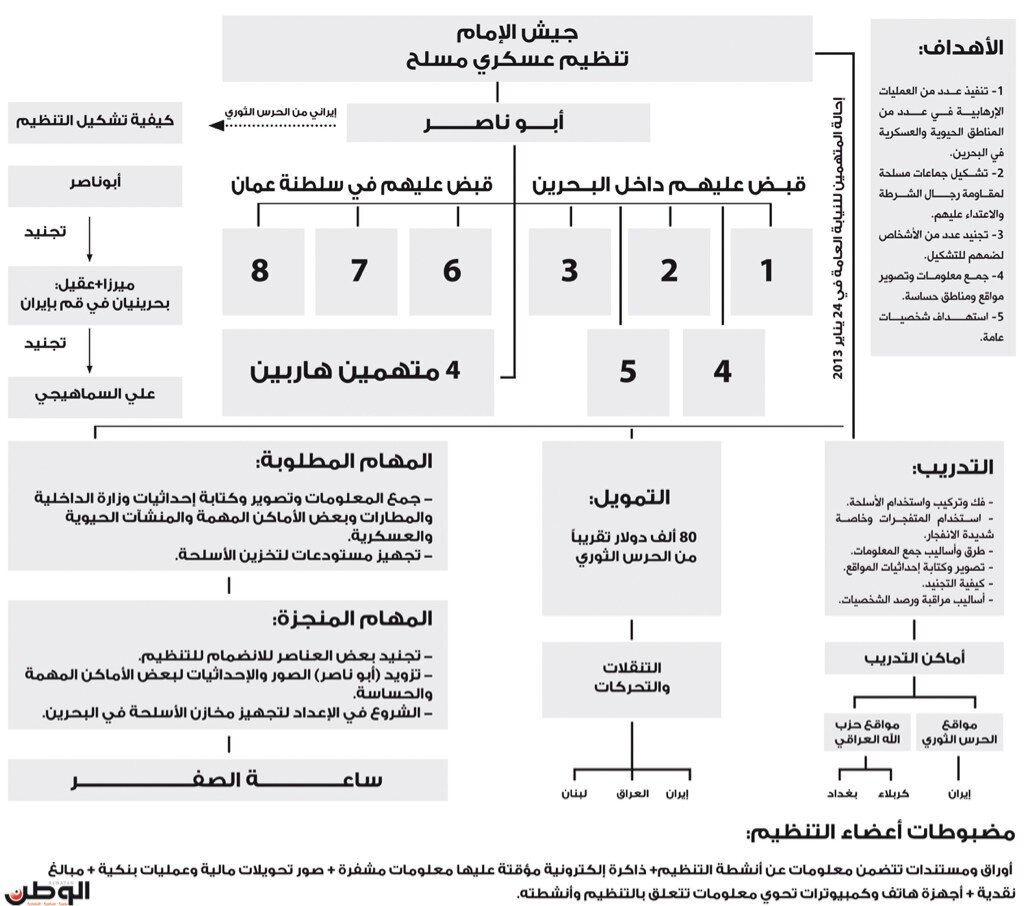
Update: I guess I should have waited a day to post on Bahrain's possible spoiler groups. A tweet yesterday by Al-Watan editor-in-chief Yusif Al Bin Khalil pointed me to this menacing flowchart of the "terrorist network"--purportedly called the "Imam's Army"--uncovered lately by the Interior Ministry.  If you wish to see the impressive advancement in Al-Watan's scientific terrorist network diagramming capabilities over the past two years, please compare this new chart to that of September 2010.


Update 2: Opposition activists post photos of foreign-language (Tamil, I think) fliers in Manama and Gudaibiya promising 10 BD to anyone who attends this Thursday's pro-government rally at the al-Fatih Mosque.

Thursday, February 14, 2013

Visualizing Bahrain


Inspired no doubt by my pathbreaking and/or monumental 2009 survey of the country, researchers increasingly are producing informative quantitative analyses of various aspects of Bahraini politics and society. Recently I highlighted a Columbia grad student's social network analysis of Bahraini opposition and media networks.  Now several additional projects have come online, and still others are in the works.

One is a more interactive, Google-enabled version of my study of electoral gerrymandering by the people at Bahrain Watch. (Yes, I understand the political views of the group, but that doesn't mean its analysis in this case--based on public election data--is somehow biased or to be avoided or ignored.)  The results are represented in the two maps above, which reveal the discrepancies in electoral representation across Bahrain's 40 districts, and how these serve to systematically under-represent constituents in opposition-dominated (in practice, more Shi'a-populated) districts.

A second study that just came to my attention is a website by one 'Ali al-Mussawi called Bahrain Visualized, which presents an interactive chart depicting the deaths of Bahraini citizens since the beginning of the uprising. (Again, before someone writes in to ask, "Where are the police deaths!??!!111one," I appreciate that the data are not being employed for non-partisan purposes, but that doesn't mean that they aren't still useful or original.)  This is particularly relevant with the news today that anniversary clashes between protesters and police have resulted in the death of one 16 year-old boy.


So, again, it's good to see this increased application of more empirical-based methods to the Bahrain and larger Gulf context.

Update: An anonymous commenter points out another recent empirical analysis of Bahrain, this one by Carnegie and focusing on the question of political naturalization:


Update 2: More attempts to play spoiler: attacks on police and a (diffused) bomb on the Saudi causeway.

Update 3: Riddle: if a country uncovers dozens of fake Iranian-backed terrorist cells, how do you know when it actually uncovers an Iranian-backed terrorist cell?

Wednesday, February 6, 2013

Bahrain's New Dialogue: Sending in the B Team

It might have taken 18 months, but dialogue fever is finally back in Bahrain.  The new talks, set to begin on Sunday, represent the first such effort since the infamous "National Dialogue" of summer 2011.  A more recent attempt in early 2012 sponsored by Royal Court Minister Khalid bin Ahmad failed after a boycott by Sunni societies and a general lack of foresight, seemingly, on the part of the government.

Sunday's talks would seem to represent a conceptual and organizational middle ground between the two efforts.  The 2011 National Dialogue was based on the principle of "fighting dialogue with more dialogue," and to this end the government invited all Bahrainis (and expatriates) capable of verbal communication.  The final list was something like 300 participants, including group representatives and individuals.  The formal opposition had perhaps 5 seats.  Not only this, but the process was chaired by Speaker of Parliament and long-time Khalifa bin Salman crony Khalifa al-Dhaharani, rendering the entire event something like a glorified National Assembly session--but one that was somehow even less efficacious.

The effort led by the royal court early last year attempted the opposite--and for Bahrain more traditional--approach, inviting only opposition societies to a process that was not public and about which there was much speculation.  Indeed, Sunni societies such as the National Unity Gathering, under the impression that they had been invited, announced a boycott of the talks, whereas Sahwat al-Fatih opposed them precisely because they had not been invited.  Finally, the NUG figured out the same thing, and the two joined together to call for Sunni inclusion.  Seemingly caught off-guard, the state pulled the plug on the talks, and rumors and vague newspaper articles telling of coming dialogue stopped.

Thus we arrive at the talks to begin Sunday, February 10, a convenient four days before the anniversary of the uprising.  Imagine that!  The official statement from the BNA is here, but the upshot is an odd 8-8-8 ratio of representatives from parliament (including from the Shura Council), opposition societies, and what are being called "nationalist" political societies. The latter "National Coalition" includes the National Unity Gathering, al-Asalah, al-Manbar, and the aptly-named and presumably just-created "National Dialogue Society."  Interestingly, Sahwat al-Fatih is not among the participants.  (The full list of participating organizations is here.  Unlike with the 2011 National Dialogue, they can be listed on only one page of a newspaper.)

Beyond this it gets quite confusing on various fronts.  First, the Gulf News reported the day before yesterday that "each of the alliances will be represented by six people" rather than the eight it is now reporting.  And one of the "nationalist" groups has already dropped out.  So it is clear that the design of the meetings is still very much in question and that adjustments are ongoing.

Second, and more important, it's still not clear what will be the government's role or indeed the exact format of the meetings.  The government's original position--that it would "organise and moderate the talks, but would not be an interlocutor"--has been roundly criticized by both al-Wifaq and the supposedly-pro-government "nationalist" societies.  Asked by the BBC to clarify, the government gave this response: "Representatives of the government's ministries will be present at the dialogue to oversee and make suggestions if needed, but will not be there to take part in the dialogue itself." So, it's exactly as they said: the government will take part but won't participate.  Why is that so hard for you people to understand?

Finally, according to the dialogue's patron Justice Minister Khalid bin 'Ali, "there would be no time limit for the dialogue and that the agenda would be set by the participants when they meet on Sunday. The outcome would be recommendations endorsed by the participants that would be conveyed to the parliament for approval." So, not simply is the entire process subordinated to the opposition-less parliament, but indeed a third of the delegates to the talks already ARE members of parliament.  So the full parliament will ratify recommendations negotiated by a subset of the parliament along with opposition and "nationalist" non-parliamentarians?  An odd setup.

For their part, al-Wifaq do not wish to wait to find out how all of this is going to shake out.  The Gulf News reports that the group is pushing for a postponement until a clearer and more efficacious format and follow-up process is decided, preferably bilateral talks between the opposition and the government.  The problem, of course, is that this would mess up the state's right-before-February-14 timing and even, depending on one's degree of cynicism, defeat the entire purpose of the initiative.  Whatever the case, in the end we are left with the following two familiar sentiments from the opposition and pro-government sides, as told by the Gulf News:
Opposition figures, addressing a press conference, said that they wanted more details before the start of the talks. “We will ask for more details about the format of the talks,” they said on Monday. “We want also to know more about the aspects and outcome of the talks, including the fairness of the representation is, the agenda, the time frame, the moderation, the role of the government, the outcome and the guarantees by the authorities,” they said.

The National Alliance, an umbrella for nine political formations after one group pulled out, on Tuesday said that it was ready for the talks, but said that it would push for an end to street violence “to ensure a positive context for the dialogue.” “We do not want to be part of the dialogue merely for the sake of having talks,” Ahmad Juma, the head of the alliance, said. “We want to have a clear and positive for the dialogue platform for the talks by insisting on an end to all forms of violence. We reject the use of violence to exert pressure and we refuse any foreign interference in the talks. We will simply walk out in case there is foreign interference,” he said.
In other words, al-Wifaq is skeptical about the seriousness of the talks and may choose not to participate, and Sunni societies are skeptical of al-Wifaq and may walk out.  That sounds about right. (For the more optimistic view of Mansur al-Jamri, see here.)

Sunni cartoonists now will need to learn how to draw Russians.

As if to antagonize its fellow dialoguers further, al-Wifaq is opening up a whole new front on the question of "foreign interference" with its announcement yesterday that it has accepted an invitation from the Russian Foreign Ministry to visit Moscow to "exchange views on how to exit the political crisis in Bahrain."  (Al-Wasat has transcribed a lengthy interview, which also includes questions about the dialogue, here.)  The "delegation," whose members as far as I can see have not been named, begins today and will last until the scheduled beginning of the dialogue on February 10.  This is being billed as an attempt to apply pressure on the Bahraini government.  In the meantime, I doubt any Sunnis will make the connection between this visit and Russian support for Iranian-backed Bashar al-Assad.


As for the second concern of Ahmad Juma, violence, the situation is perhaps equally bleak.  The February 14 Coalition and others have organized an extensive schedule of protest activities spanning February 1-16 that is likely to feature violent altercations between demonstrators and police. There is even increasing worry, I am told, of more organized spoiler attacks on police or even civilian populations meant to derail the dialogue process and the formal opposition's "abandonment" of the revolution. This would assume that the perpetrators had confidence in the seriousness of the talks, however, which would seem doubtful.


That said, and for what it's worth, I've been told that the Justice Minister--not to say the Justice Ministry generally--intends for the talks to be serious, and that he is seen as having stuck his neck out in leading the effort. This is reflected, it is said, in the participation of additional, yet-unnamed ministers, who presumably will represent other factions of the ruling family who do not necessarily support the process or are worried about it veering out of control. Further, it is said, the lack of crown prince involvement is not because the initiative is unrelated to his surprise call for dialogue at the Manama Dialogue, but because moderates do not wish to see a repeat of the crash-and-burn of March 2011.  Thus, as the person explained it, Bahrain is sending in "the B team" at a time when use of "the A team"--Sh. Salman--would seem risky and premature.  Unfortunately, one can envision how this strategy, insofar as it can be viewed as evidencing a lack of seriousness, may obviate the need for the A team altogether.

Update: Apart from the kickoff today of the new and improved national dialogue, there are several interesting stories this morning.  One is an upgrade in Bahrain's economic outlook from "poor" to "stable" by S&P. Two others involve the Khawalid.  First, Defense Minister Khalifa bin Ahmad has said in an interview with Al-Arabiyya that the Iranian threat compels GCC countries to seek to acquire nuclear weapons.  A second story in the Bahrain Mirror claims that the real reason behind the January 20 resignation of BAPCO CEO Gordon Smith is his refusal to comply with a Royal Court order to hire 120 soldiers from the Ministry of Defense to replace Shi'a employees.

Update 2: After an internal meeting yesterday, al-Wifaq has now officially agreed to take part in the talks, although it is clear that they don't know exactly what they're getting into.  In an interview with The Independent before his trip to Moscow, 'Ali Salman is quoted as saying,
We sent a letter to the Bahraini Justice Minister [who will moderate the talks] but they will just be between the opposition groups and government loyalists, not members of the royal family themselves. The talks themselves are also vague – will they lead to an agreement on reform, or just advice to the government?
Indeed, it would seem that the best case scenario here is that the initiative will serve as a confidence-building measure that might then lead to a separate, probably quieter process that does stand some chance at resolving substantive political disagreements. But we certainly are not at that stage yet.

Update 3: Emile Nakhleh on "Obama and Bahrain: How to Save Al-Khalifa Rule." Hint: give Khalifa bin Salman the boot.

And this highly-recommended piece from an unlikely source: Admiral Dennis Blair, former Director of National Intelligence and Commander in Chief of the U.S. Pacific Command, who writes of the "False trade-off on Bahrain."

Update 4: Perhaps the first big business casualty of "political instability" in Bahrain is, curiously, the main domestic competitor of the flagging (and political flashpoint) Gulf Air. As one analyst quoted in the USA Today candidly notes, "The Bahraini government is looking to re-energize Gulf Air at the expense of facilitating growth for Bahrain Air."

Also: hopefully the first and last of would-be "spoiler" attacks (or scare tactics) coinciding with the second anniversary of the uprising and/or the recently-begun "dialogue."

Wednesday, January 23, 2013

Bahrain's Latest Call to Dialogue: Détente or Diversion?

"Ok, guys, we've got two hours to agree on everything."

Yesterday's news that Justice Minister Khalid bin 'Ali has been tasked by King Hamad to restart political "discussions" has been greeted with some cautious optimism. This latest step toward renewed talks comes some six weeks after Crown Prince's surprise call for such an initiative at the Manama Dialogue, a proposal that seemed encouraging on several levels.  Naturally, the (foreign) media have connected yesterday's announcement with Sh. Salman's earlier call, in which case one is perhaps justified in remaining optimistic.  Yet looking at the design and official description of these new "discussions," it is not at all clear that they are one and the same with the Crown Prince's plan.  In which case there is must less reason for hope, and Khalil al-Marzuq's stated worry that the latest announcement may be no more than a "seasonal call for dialogue" is likely right on target.

Looking at the official BNA press release, there are several worrying elements.  It reads:
Based on the royal guidance of His Majesty the King, the Minister of Justice will invite representatives from the political societies and independent members of the political community in Bahrain to resume discussions of the political dimension which was initiated during the National Dialogue. The topics on the dialogue agenda will be those pending issues which have consensus to be listed. This process is aimed to develop further consensus around the political agenda.

This is comes in conformity with His Majesty’s speeches emphasizing on his continued support for a purposeful and serious dialogue as long as it serves the Kingdom and its people.
The first notable fact is the conspicuous omission of any reference to the crown prince's statement at the Manama Dialogue.  In fact, the announcement appears to go out of its way to disassociate itself with the latter, stating explicitly that the initiative is "[b]ased on the royal guidance" of King Hamad and "comes in conformity with His Majesty's speeches."  So, again, nothing about Sh. Salman, an omission that suggests perhaps that his more moderate faction is not the force behind the initiative.

The second worrying element is the mere mention of the National Dialogue of summer 2011, which represents without question the single most farcical and disingenuous initiative of all the farcical and disingenuous initiatives witnessed since February 2011.  Couple this with a statement of support for the new "discussions" by Khalifa al-Dhaharani, the distinguished troupe leader of the National Dialogue (who just happened to have a meeting with the king yesterday), as well as the reference to "independent members of the political community," and one's imagination runs wild.

Moreover, the statement seems to skirt around the question of who precisely was "invited" to the "discussions."  Al-Wifaq we know is included, but has the offer been extended only to the opposition?--or only to the formal opposition (i.e., not to the Feb. 14 coalition)?  The open reference to "political societies" and "independent members of the political community" would seem to suggest that the discussions would not be limited to the opposition.  Yet some reports, including one by the usually-reliable Habib Toumi at Gulf News, are running with the headline, "Bahrain king extends talks invite to opposition."  Whatever the case, the vague language stands in stark contrast to that of Crown Prince Salman, who made explicit mention of the inclusion of Sunni and Shi'i groups, a condition that will surely make or break the entire enterprise.

Finally, apart from the actual text of the initiative, one can note two additional observations. The first is the patron of this new initiative, Sh. Khalid bin 'Ali, who over the previous two years has overseen the dissolution of two opposition societies--Wa'ad (temporarily), and 'Amal--and, on repeated occasions, the attempted dissolution of al-Wifaq itself.  The most recent of these efforts/threats to ban al-Wifaq took place only in September, when the group and Sh. 'Isa Qasim came under pressure by the Justice and Islamic Affairs Ministry, which Sh. Khalid heads and which has legal jurisdiction over Bahrain's political societies.  More generally, Sh. Khalid bin 'Ali bin 'Abdallah bin Khalid is a distinguished member of the Khawalid (a subject that has been occupying much of my time lately), which is to say a member of the ruling family not predisposed to offering substantive political concessions.

Last is the larger regional and perhaps international political context of the announcement.  On the one hand, with the anniversary of the uprising is less than a month away, it is perhaps expected that the state would revert to its old trick of what al-Marzuq calls "seasonal call[s] for dialogue" aimed at diffusing pressure at opportune times.  In line with this interpretation, one Bahraini contact estimates that the effort "seems to be part of a broader plan by the authorities ahead of the crucial second anniversary of 14 Feb." 

On the other hand, one can also identify several external factors that could be conspiring to give King Hamad a kick in the pants on the issue of dialogue.  Second-term "I do what I want!" President Obama has nominated as secretaries of state and defense two individuals who likely represent a different take on the United States' proper role in the Middle East, its stance on Iran, and indeed its strategic goals throughout the rest of the world.  At the same time, Bahrain's oldest great-power patron Britain is in the middle of its own formal parliamentary review of relations with Bahrain and Saudi Arabia. See, for example, Jane Kinninmont's testimony to the committee yesterday:


These hints at changes in philosophy may not translate into substantive changes in the U.S. or British relationship with Bahrain or Saudi Arabia, but the mere suggestion may be enough to prompt Gulf leaders to take more deliberate steps to ensure their own long-term security and stability, including by making headway on addressing longstanding political grievances.  (Say, in Saudi Arabia's case, by appointing women to the Shura Council.) That Bahrain's announcement came just a day after the end of the GCC summit in Riyadh, where the focus reportedly was on the Arab Spring and meeting "people's aspirations," is interesting in this regard.  As always, however, only time will tell.

Update: Well, it seems that Sunni groups certainly are under the impression that they've been invited. (Although this impression has proved erroneous in the past.) The National Unity Gathering has welcomed the dialogue and in fact held public meetings with constituents last night.
Update 2: Not everyone is such a fan, however. The Bahrain Mirror reports that official army spokesman and Internet funnyman Khalid Al Bu'Ainain referred to the dialogue ("al-hiwar") yesterday as "al-himar"--that is, "the jack-asses"--in a Tweet. Hilarious.

Update 3: Blast, another setback!  Al-Wifaq, perhaps in an attempt to demonstrate its control of the Shi'a street and/or ability to mobilize popular support for the dialogue, calls for a rally in Manama.  The Interior Ministry denies permission for the rally.  Members of the youth movement instead take to the streets to denounce the talks, shouting "no dialogue with killers."  Interior Ministry responds with tear gas and stun grenades.  Al-Wifaq looks out of touch and lacking in influence where it matters.  Government likely wonders what good will be a dialogue (and the possibility of a political deal) if the opposition cannot put an end to protest activities even if it wanted.

Coming soon: dialogue falls apart.

Update 4: Here we go.  'Ali Salman tells the BBC that al-Wifaq wants "someone who can speak for the ruling family" at the proposed talks, namely Crown Prince Salman.

Update 5: For those in Washington on Feb. 13, Carnegie is hosting an event titled "The Precarious Ally: Bahrain’s Impasse and U.S. Policy in the Gulf" featuring, inter alia, Toby Jones, Frederic Wehrey, and Matar Matar.